



The People Who Make Up a Life
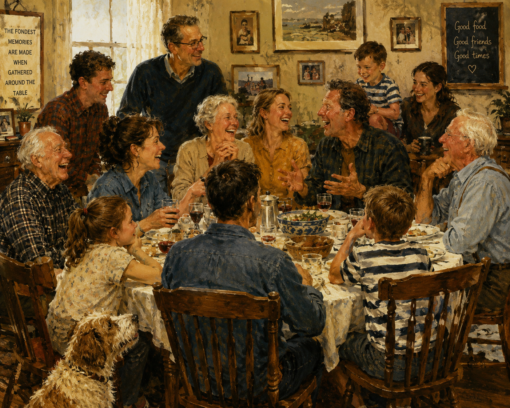
I’ve spent a lot of time writing about things I’ve done, places I’ve been and ideas I’ve had. But when you look back over a life, the things that matter most usually aren’t things at all.
They’re people.
Family. Friends. People who were around for decades and others who passed through for a relatively short time but somehow left something behind.
That’s what this part of the site is for.
I’m not interested in turning my private life into public entertainment, and there are things that will always belong only to the people involved. But there are also stories I don’t mind sharing.
Sometimes it might be a family event or a photograph that brings back a memory. Sometimes it’ll be something one of my kids said twenty years ago that I can suddenly hear perfectly in my head. It might be a story about becoming a grandfather, an old friend, someone I miss, or a relationship that taught me something I didn’t understand at the time.
Some will be funny. Some will probably be sentimental. Others might simply be a way of remembering someone or recording a moment before another twenty years somehow disappears.
Friendships interest me too. The people we choose, the ones who stick around, the ones we lose touch with and occasionally find again. As I’ve gotten older, I’ve realized how much of who we become comes from the people we’ve known.
There won’t necessarily be a lesson at the end of every story.
Sometimes something happened.
Sometimes someone mattered.
Sometimes I just want to remember it.
That’s enough reason to write it down.
on
Building Things and Watching Them Change
I’ve always liked building things.
Not in the hammer-and-nails sense. Businesses. Ideas. Places. Teams. Taking something that exists mostly in your head and seeing whether you can turn it into something people will actually walk through the door and pay for.
I’ve owned restaurants, built music schools, worked in media and creative businesses, and started more than a few projects over the years. Some became successful. Some lasted longer than I expected. Others taught me very expensive lessons.
That’s business.
What interests me about it isn’t really the corporate world. It’s the human side of entrepreneurship. The excitement of opening the doors for the first time. Making payroll when things are tight. Hiring someone and watching them become great at what they do. Figuring out why customers love one idea and couldn’t care less about another.
And then there are the mistakes.
I’ve made plenty.
I’ve learned that being right about an idea doesn’t necessarily mean you’ve figured out how to make money from it. I’ve learned that growing can create as many problems as struggling. I’ve learned that the numbers eventually get a vote, regardless of how much you love what you’ve built.
I’ve also learned that sometimes things end.
That doesn’t necessarily mean they failed.
This section is where I’ll write about those experiences. Restaurants, entrepreneurship, customer service, employees, money, marketing, ideas that worked, ideas that didn’t and the strange reality of trying to build something from scratch.
I’m not writing any of it as a business guru.
God knows there are enough of those.
I’m writing as someone who’s spent a good part of his life building things, occasionally watching them fall apart, and then, for reasons I’m still trying to understand, deciding to build something else.
on

The Things You Pick Up Along the Way
I’ve never been particularly interested in following one straight road through life.
I’ve worked in radio and newspapers. I’ve built businesses, owned restaurants, taught music, worked in creative roles and spent thousands of hours driving around cities talking to people I probably never would have met otherwise. I’ve had ideas that worked, ideas that didn’t, businesses that grew and things I cared about that eventually disappeared.
And I wouldn’t trade the variety for a more impressive-looking résumé.
I’ve always been driven more by experience than accumulation. I wanted to know what it was like to do something. To build something. To walk into a room where I didn’t quite belong yet and figure it out. To meet people whose lives looked nothing like mine and hear their stories.
Some experiences lasted years. Others were brief chapters. Almost all of them left something behind.
There’s another part of my experience that I don’t talk about for sympathy, but I don’t particularly want to hide either. I live with ankylosing spondylitis. It’s part of the deal. It affects some days more than others, and over the years I’ve learned how to work around it, work through it and occasionally accept that it gets a vote too.
It’s not a crutch. It’s not an excuse. And it’s certainly not the most interesting thing about me.
It’s simply one of the realities that has travelled with me through a lot of these stories.
That’s what this section is about. The stories.
It might be something from my radio days, something that happened in one of my restaurants, a person I met while driving, an old friend I suddenly remembered, a business lesson I learned considerably later than I should have, or one of those moments when life takes a turn you couldn’t possibly have planned.
There have been successes, failures, absurd situations, wonderful people, difficult people and more than a few occasions when I had absolutely no idea what I was doing.
Those may have taught me the most.
I don’t look at the different things I’ve done as separate careers anymore. They’re experiences. Collectively, they’ve shaped how I write, how I see people, how I understand business and even how I approach public life.
You pick things up along the way.
Eventually, you realize you’ve got some stories to tell.
on
Why I Write
I’ve never really thought of writing as something separate from the rest of my life. Usually, I write because something gets into my head and refuses to leave until I’ve worked my way through it.
Sometimes it’s Canada. Sometimes it’s politics or business. Sometimes it’s a person I met thirty years ago, a restaurant that disappeared, something that went spectacularly wrong, or an experience that seemed completely ordinary at the time and became much more interesting years later.
That’s probably why my books don’t stay in one lane.
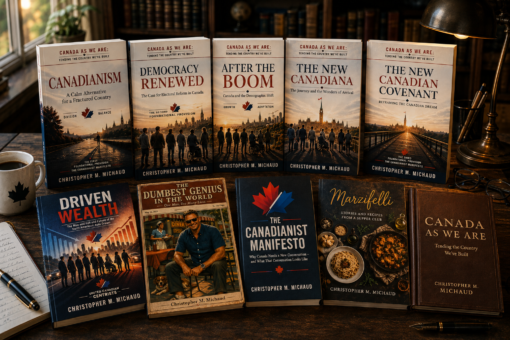
I’ve written about Canada in books like Canadianism and Democracy Renewed, trying to understand the country we have, how we got here and what we might do differently. Other books come from a completely different place. The Dumbest Genius in the World looks back at a life spent chasing experiences more often than money, while Marzitelli comes from the restaurant world and everything that happens when people, food, business and ambition collide.
There are more coming.
I’m working on a memoir that pulls together some of the stories I’ve accumulated along the way. Radio, business, restaurants, people I’ve known, things I’ve built, things I’ve watched fall apart, places I’ve lived and some decisions that seemed perfectly reasonable at the time.
That last category may require several chapters.
This section is also where I’ll share shorter pieces, excerpts, works in progress and occasionally something that doesn’t have an obvious home anywhere else.
I don’t write because I believe I’ve figured everything out. Quite the opposite. Writing is often how I figure out what I actually think about something.
Sometimes that becomes a book.
Sometimes it’s a thousand words.
Sometimes it’s just a story worth telling.
And I’ve still got quite a few of those left.
on

Canada Is More Than Politics
Canada has occupied a lot of space in my head over the years.
Not just Canadian politics. Canada.
The places, the people, the differences between regions, the things we complain about and the things we don’t appreciate nearly enough. I’ve lived in Quebec, Ontario, big cities, suburbs and smaller communities. I’ve driven through an awful lot of this country, talked to people from just about every walk of life and discovered that Canada usually looks considerably different from ground level than it does from behind a desk.
That’s what this section is for.
There are other places for my political writing. The Canadianist covers Canadian news and public affairs. The United Canadian Centrist Party has a website for policies, ideas and the work we’re doing there.
This isn’t either of those.
Sometimes I might write about a town I stopped in and didn’t expect to like as much as I did. A restaurant somewhere that deserves more attention. Something distinctly Canadian that we’ve somehow stopped noticing. A conversation with someone I met along the way. A bit of history. A place worth visiting. Something we’re doing particularly well. Something that drives me absolutely crazy.
Maybe I’ll write about Montreal one week and some little place along Highway 11 the next.
There’s no mandate here other than Canada.
I’ve always been fascinated by the fact that this enormous, complicated country somehow holds together despite our geography, our regional differences, two official languages, wildly different histories and our occasional determination to irritate one another.
Maybe that’s part of what makes it interesting.
I spend plenty of time thinking seriously about where Canada is going.
This is where I get to enjoy where Canada is.
on
How I Ended Up in Politics
For most of my life, politics was something I watched, wrote about, argued about and occasionally yelled at the television about. I never grew up dreaming about holding office, and I certainly never imagined building a political party.
What interested me was Canada.
Over the years, I became increasingly frustrated by how difficult we’ve made it to have an ordinary political conversation. Everything needs a team. Every idea needs a label. If a Conservative proposes something, Liberals are expected to hate it. If a Liberal proposes something, Conservatives are supposed to find the fatal flaw before lunch.
Meanwhile, most Canadians are just trying to live their lives.
That’s eventually what pulled me from commenting on public life into participating in it. I founded the United Canadian Centrist Party because I believe there’s room for a different kind of politics, one that isn’t frightened of borrowing a good idea from the other side and doesn’t pretend compromise is surrender.
I don’t expect everyone to agree with me. In fact, I’d be suspicious of anyone who did.
Public life should be a conversation between people who care enough about their country to disagree, listen, reconsider and occasionally admit the other person has a point.
That’s also what this section of the site is going to be about.
The Canadianist has its purpose. The party website certainly has its purpose. This isn’t either of those.
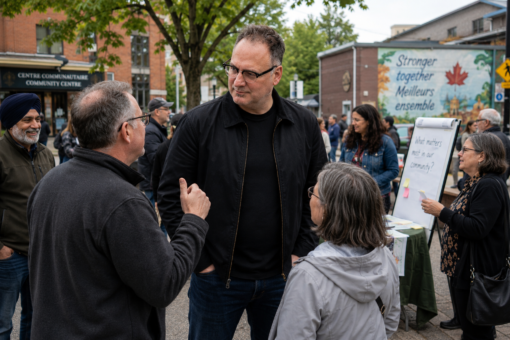
This is where I’ll share some of what happens around the edges. Experiences from the road. People I meet. Things I see while travelling around for the party or The Canadianist. Behind-the-scenes moments that don’t really belong in a news story or a policy paper. Occasionally something that made me laugh, surprised me or left me thinking about it three days later.
Some of these stories might only be interesting to me and a handful of other people. That’s okay too.
I’m still a writer. I’m still an entrepreneur. I’m still the guy who can spend an unreasonable amount of time thinking about restaurants, radio, music, books and what we’re having for dinner.
I just happen to be involved in politics now, too.
Not because I believe I’m the person who’s going to fix Canada.
Because I believe we can do some things better.
And there should be a few good stories along the way.
on
Waiting for the Bandit
Owning a music store was one of the most fun periods of my life.
If you’ve ever been inside a small neighborhood music shop, you know the vibe. Guitars hanging everywhere, the smell of wood and strings, a drum kit in the corner someone isn’t supposed to touch but always does. For a while, I lived inside that world.
But the truth is, small music stores live in the shadow of the big ones.
In Montreal there was one dominant store. Everybody knew it. Their slogan said everything:
“If we don’t have it, you don’t need it.”
And unfortunately, most of the time, they were right.
The big shops had the exclusive lines. Gibson. Fender. Marshall. The brands everybody wanted. Those companies often locked their products into the biggest dealers in the city. If you were a small independent shop, you simply didn’t get access unless you could buy huge quantities.
And when you’re running a little 700-square-foot store in a suburban mall, buying hundreds of Gibsons simply isn’t an option.
So people would come into my shop and ask the question.
They always asked the question.
“Do you carry Gibson?”“Got any Fenders?”“Where are your Strats?”“I don’t see any Les Pauls.”
Most of the time they already knew the answer.
Sometimes it felt like curiosity. Other times it felt like they were just reminding me where I sat in the food chain.
One day I had enough.
A guy walked in, looked around the wall of guitars, and asked the usual question.
“Where are your Les Pauls?”
Something in me snapped.
I looked at him and said calmly,
“Oh, I have Les Pauls.”
He looked surprised.
“Actually,” I continued, “I have two models that nobody else in Canada has.”
His eyes widened.
“The thing is,” I said quietly, “Gibson made me promise I wouldn’t tell anyone. They’re in the back room. If someone wants to see them, they have to pay. It’s part of the contract.”
I expected him to laugh and walk out.
Instead he reached into his wallet, pulled out a ten-dollar bill, and said,
“Okay. I’ll see them.”
I burst out laughing and handed the money back.
“Keep it,” I said. “I’m kidding. I don’t have any Gibsons.”
But it was worth it.
That first year in the store we sold 900 guitars.
It was the last big guitar boom I remember. Everybody wanted to play. Guitar was the coolest thing in the world.
If you ask me, you can credit Green Day. American Idiot was everywhere. “Wake Me Up When September Ends” was playing in every store and on every radio. Kids wanted guitars again.
Around that time one of my distributors introduced something new, the first “guitar in a box” starter kits.
For $299 customers got an acoustic guitar, a soft case, a book, picks, straps, accessories, everything you needed to start playing.
It was perfect for Christmas.
My distributor told me if I wanted the best price, I had to buy an entire container.
“How many in a container?” I asked.
“Three hundred.”
Three hundred guitars.
For a small store, that was insane.
But I had already sold a few at the higher price and they were moving fast. So I did what a dumb genius does.
I said yes.
I committed to the whole container.
And somehow, unbelievably, I sold them.
Not only did I sell them, I sold all of them before they arrived.
Customers paid deposits and reserved them as Christmas gifts.
The distributor told me the shipment would arrive about ten days before Christmas so people could pick them up in time.
Perfect.
Then the emails started.
First delay.
Then another.
Then another.
Finally on December 22nd I got the news.
The container had arrived in Canada.
But the guitars were stuck in Toronto.
My store was in the suburbs of Montreal.
And the guitars wouldn’t arrive until after Christmas.
Which meant three hundred people were about to discover that the Christmas gifts they bought from my store did not exist.
So I panicked.
My father had been vice-president of a courier company before he passed away when I was fifteen. I was still close with the owner, so I called him.
“Paul,” I said, “I have a problem.”
He listened.
Then he said, “Call this guy.”
“Who is this guy?”
“Trust me,” he said. “He’ll get it done.”
So I called.
The guy said he’d drive to Toronto, pick up the guitars, and bring them back.
Price?
Five hundred dollars.
I didn’t hesitate.
Deal.
That night the store closed and my usual crew, Nick, Matt, and Scott, came over to my place.
We were sitting in my garage playing poker, drinking beer, waiting.
Waiting for a stranger to drive five hours to Toronto, load three hundred guitars, and come back through the winter night.
Around two in the morning there was a knock on the garage door.
We opened it.
There stood a guy who honestly looked like he had stepped out of the movie Smokey and the Bandit, beside a truck full of guitars.
“You Chris?” he asked.
“I got your stuff.”
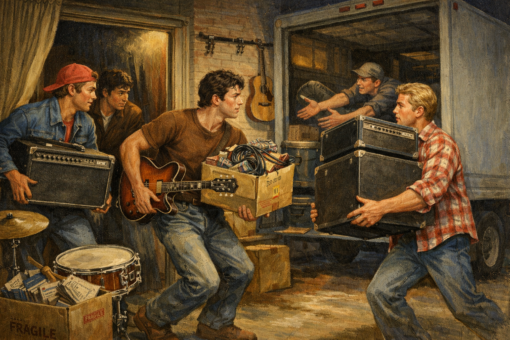
We unloaded everything into my garage.
Just like that.
The next morning we packed the guitars into the store.
Remember, the shop was only 700 square feet.
Three hundred guitars took up every inch of space. Customers could barely squeeze through the door to reach the counter.
But we had emailed everyone to come pick them up on Christmas Eve.
And they all showed up.
When we opened the door that morning we heard a crowd outside.
We figured a few people had arrived early.
Instead there was a line around the corner of the mall.
You would have thought Green Day themselves were inside signing autographs.
Mall security came over asking if we had planned some kind of event.
“No,” I told them.
“We’re just handing out guitars.”
Three hundred people came through that door that day to pick up their Christmas presents.
And somehow it all worked.
It was a great Christmas.
And every time I run into Nick, Matt, or Scott, which sadly isn’t as often as it used to be, we still laugh about that night.
The night we sat in my garage playing poker.
Waiting for the Bandit.
on
 The People Who Make Up a LifeAugust 10, 2026
 Building Things and Watching Them ChangeAugust 10, 2026
 The Things You Pick Up Along the WayAugust 10, 2026
 Why I WriteAugust 10, 2026
 Canada Is More Than PoliticsAugust 10, 2026
Recent Comments