
Stories
Buying My Way Onto the Radio

In life, most people go through a few chapters. Some people spend their entire career in one field. Others move into a second phase later in life. Sometimes you see it with athletes; they retire early and reinvent themselves. Sometimes it’s someone who just gets fed up with a job and jumps into something completely
In life, most people go through a few chapters.
Some people spend their entire career in one field. Others move into a second phase later in life. Sometimes you see it with athletes; they retire early and reinvent themselves. Sometimes it’s someone who just gets fed up with a job and jumps into something completely different.
My life has had many chapters.
The difference with me is that money was never the main thing that motivated me. Of course I wanted to make money, everybody does, but it was never the reason I got out of bed in the morning.
People have different buttons that push them into action.
Some people are motivated by status.
Some by money.
Some by recognition.
For me it has always been a mix of recognition and the challenge.
Money was always nice when it came, but it was never the engine.
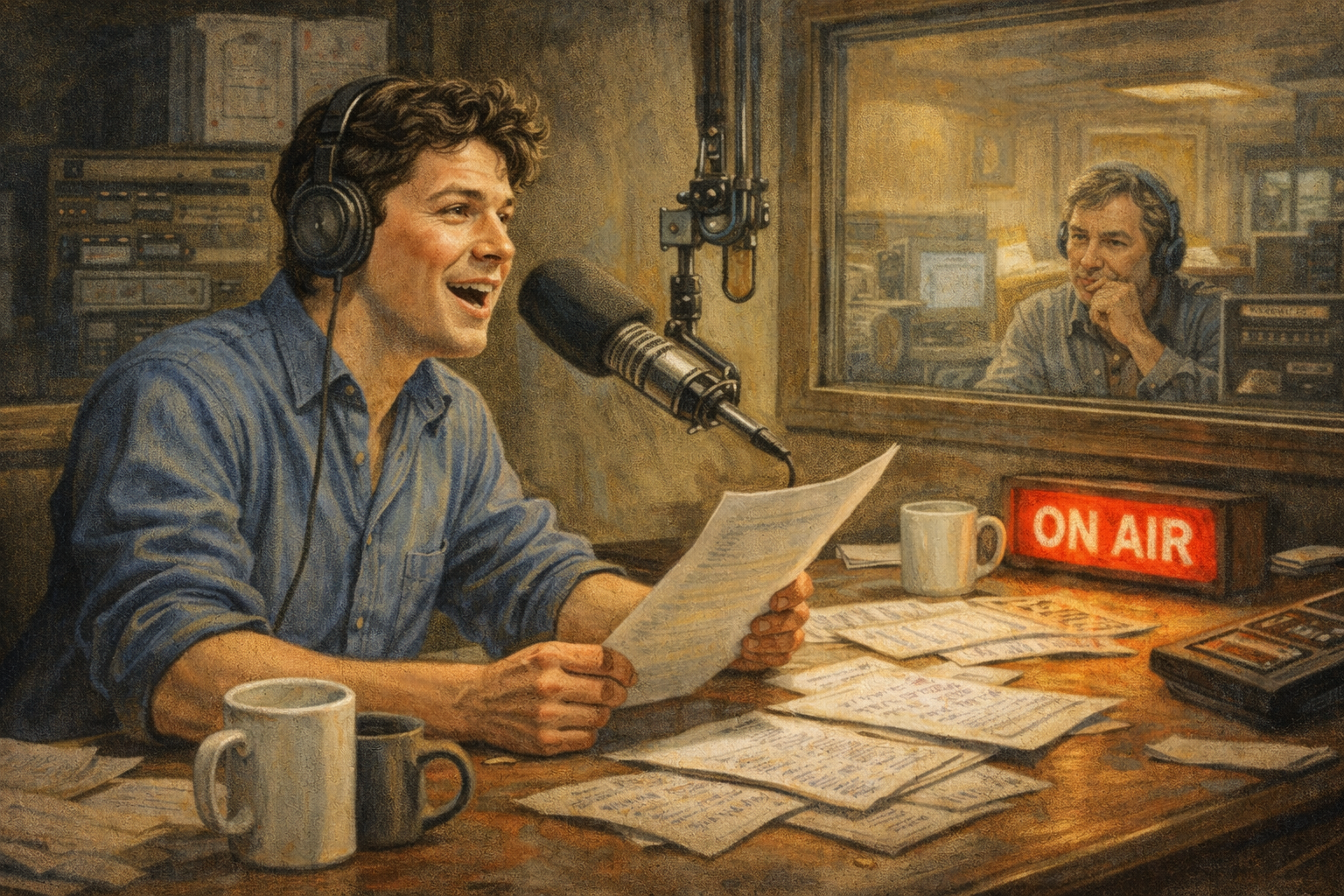
Back in my early thirties, around thirty-one, I was working as a writer at the second largest English newspaper in Montreal. I was covering sports. I wrote about amateur athletics, events around the city, whatever was happening in the sports world.
One of the highlights was covering the Montreal Alouettes Grey Cup win.
I worked with some colleagues who are still there today and doing very well. My work was well received, and the job was going fine.
But what I really wanted was to be on the radio.
So one day I went to see my editor, Jim Duff.
Jim was an old school newspaper editor. Think J. Jonah Jameson. Gruff, direct, no nonsense.
I told him, “Jim, I love working here, but I want to add something. I want to get into radio.”
Jim had actually worked in radio himself years earlier. He had famously quit a station on the air during the Montreal ice storm after a dispute between stations in the same network. It was a legendary moment in the local media world.
So he understood radio.
He looked at me and said, “Call this guy at 990 CKGM. Tell him you work for me.”
So I picked up the phone.
Eventually I was transferred to a man named Wayne, the person Jim had told me to speak to. I explained who I was and that I worked for Jim Duff.
Wayne asked the obvious question.
“Do you have any demos? Air checks? Anything you’ve done on radio?”
“No,” I said. “I don’t. But I’m confident I can do it.”
He gave me the polite brush-off.
“Well, when you get something together, give me a call.”
Fair enough.
I said thank you, and then I asked him something unexpected.
“Could you transfer me to the advertising department?”
He paused.
“Oh,” he said, “you want to start in advertising? A lot of guys do that.”
“No,” I said. “I actually want to buy advertising.”
Now he was confused.
“You want to buy advertising? What are you selling?”
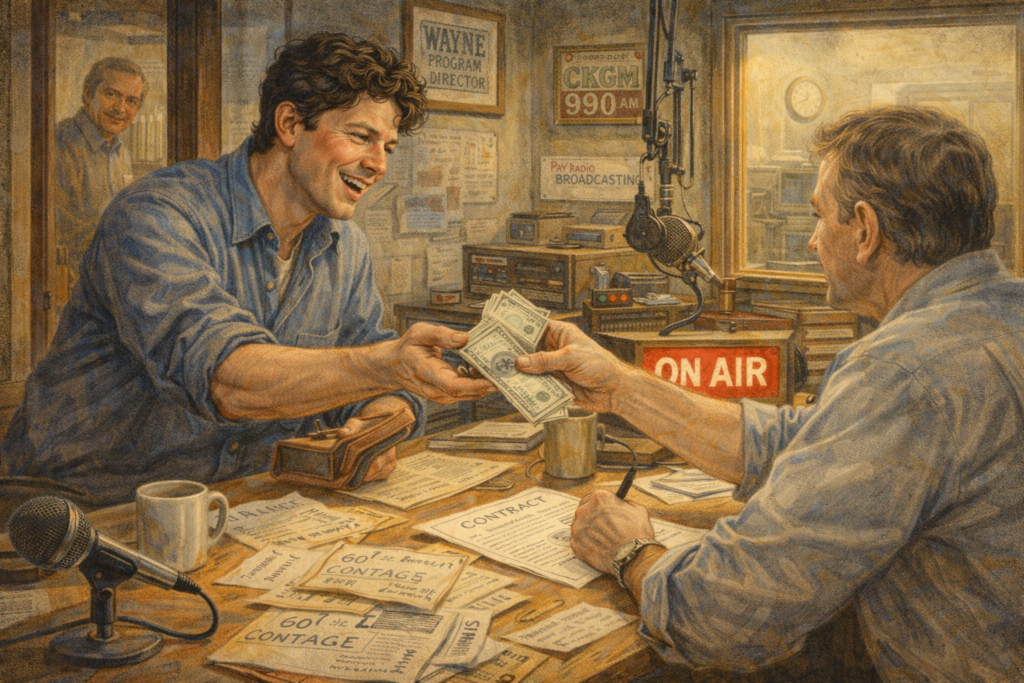
“Myself,” I said. “I want to advertise me. How much for one hour of airtime?”
He laughed.
“Okay, kid. I’ll tell you what. Sunday mornings at 8 a.m. Five hundred dollars.”
“Done,” I said.
He told me to come down with the money and we’d write up a contract.
I hung up the phone.
Now I had a small problem.
I had just agreed to spend five hundred dollars a week to be on the radio.
But I had an idea.
Before joining Jim at the newspaper, I had actually started my own local newspaper. I’ll tell that story another time, because that’s a whole adventure on its own.
But the important part is that I had advertisers.
So I called a few of them.
“Would you like to advertise on my radio show?” I asked.
They had already advertised in my newspaper and had done well with it. They trusted me.
One said yes.
Then another.
Then another.
By the end of the afternoon I had sold three advertising packages at five hundred dollars each.
That meant I was bringing in fifteen hundred dollars a week.
My airtime cost five hundred.
So every Sunday morning at 8 a.m., I was making a thousand dollars to be on the radio.
Thirty years ago, that was real money.
The show ran for about six to eight weeks.
Then the station hired me.
That became the beginning of my radio career. The show evolved into something called The Rock and Sports Breakfast. I worked closely with the station’s creative director, a guy named Scott, who became a good friend.
We had a lot of fun putting that show together.
Looking back, the funny thing is I had no demo, no experience, no résumé for radio.
So I did what I had done before in life.
I created my own opportunity.

When I first noticed the Suno app showing up last year, I assumed it was just a novelty. You’d see people talking into their phones and suddenly a little custom song would appear. It looked like something people would play with for five minutes and then forget about.
Then I opened Suno Studio.
That’s when I realized it wasn’t a toy.
Once I started experimenting with it, I could hear immediately that it was capable of producing music that actually sounded good. My first reaction was probably the same one a lot of musicians had when they first saw what this thing could do. For a moment you think, “Well, that’s it. The music industry is finished.”
A lot of musicians are having a hard time with this technology, and honestly I understand why. I’m sure a guy like my friend Dimo probably has strong feelings about it too. I don’t even have to ask him. I’ve played with Dimo professionally over the years and he still plays all over the Montreal area. He takes the craft seriously, works hard on his songs, and he’s a very good singer. Musicians like him put a lot of pride into the work.
And that’s exactly why tools like this make people nervous.
But once the initial shock wore off for me, curiosity took over.
I’ve been around music most of my life. For about ten years I owned a music school and played professionally all over the place. Outside of that stretch, most of my musical life has been writing songs, recording demos, and playing with friends. When you do that long enough, you accumulate a lot of material.
In my case it’s about thirty years’ worth.
Songs, ideas, fragments, old demos sitting around on drives and tapes and folders that never really went anywhere.
So like a lot of people experimenting with Suno, I started feeding some of those demos and song ideas into it just to see what would come out the other end.
Now before anyone jumps to conclusions, it’s important to say this clearly. These are my songs. The lyrics are mine, the melodies are mine, the chord structures and styles are mine. Some of these pieces were already complete demos from years ago. Others were unfinished when I started working with them again.
Honestly, one of the biggest challenges when I started showing some of this to people was simply getting them to take it seriously. The first reaction is usually a shrug and a joke, like I just pulled the arm on a one-armed bandit and waited to see what mystery prize the machine spit out. But that’s not what I was doing with Suno at all. Yes, you can use it that way if you want to, but that wasn’t my process. The moment you say the words “AI music,” people tend to roll their eyes and dismiss it.
Which is funny when you think about it.
For years everyone talked about how artificial intelligence was coming and how it would change everything. Now it’s finally here and the instinct is to wave it off and pretend it has no value.
In my case, when I explain what I’m doing, people say, “Yeah, yeah, it’s all AI.” But it isn’t. AI isn’t writing my songs. It’s not inventing the melodies or the lyrics. If anything, it’s acting more like my cover band, playing the material I bring to the table.
Sometimes I only had a verse and a chorus, so I finished writing the rest before running it through Suno. Other times I would generate an arrangement first and then go back afterward and complete the lyrics once I heard where the music was going.
And sometimes the process started even more simply. I’d pick up my phone and sing a rough melody into it, sometimes barely more than humming through the idea just to capture it. Suno Studio is surprisingly good at interpreting that kind of input. You can sing or even mumble a musical line and it will turn that into instruments inside the arrangement.
In a strange way it feels like skipping the keyboard interface entirely and going straight from your brain into the track.
What the whole process started to feel like wasn’t replacing musicians so much as stepping into the role of a producer. Suddenly it felt like every session player in the world was sitting there waiting for instructions. You imagine a bass line and ask for it, and thirty seconds later it’s there. If the guitar needs to lean harder into the rhythm, you adjust it and it responds immediately.
The closest comparison I can think of is those stories about Brian Wilson working with the Wrecking Crew in the sixties. I’m obviously not comparing myself to Brian Wilson, but the feeling of shaping arrangements that quickly gives you a glimpse of what that must have been like.
And I have to admit something.
My songs have never sounded this good.
At the same time, I don’t believe tools like this are going to replace real artists anytime soon. People who operate at the very top of the industry, like my longtime friend Serban Ghenea, are doing something very different. That world is about real artists, real performances, and the craft of shaping a record in ways an algorithm can only imitate.
Artificial intelligence can learn patterns and recreate styles, but it doesn’t originate culture. New ideas still come from people.
Which probably means the future isn’t humans versus AI at all. It’s more likely that the two end up working in tandem.
For someone like me, with thirty years of songs sitting in drawers and hard drives, it’s turned into a surprisingly fun way to bring some of those ideas back to life.
Below I’ll include a few links so you can hear what came out of these experiments.
Just keep in mind that most of these tracks started life as rough demos and fragments written over the last three decades.
I simply ran them through Suno to see what would happen.
And this is what we got.
One thing I will say though, the shine eventually wears off.
When I first discovered Suno I was completely fascinated by it. I spent a lot of time experimenting, running old demos through it, seeing what would happen. But like any new technology, after a while it stops being the shiny object on the table.
These days I still use it occasionally when I’m working on something online, but the big rush of experimentation is mostly over. I’ve already gone through the pile of demos and ideas I had sitting around for thirty years, and in many ways that was the whole point.
What I ended up with is something I never really had before, a collection of songs from different periods of my life that finally sound the way I always imagined they might.
And honestly, that alone made the whole exercise worthwhile.
Here’s a link to some of the stuff I did. I’d love to hear what you all think. Feel free to comment here, not just about the music itself, but about AI in general. What are your thoughts on it? And if you listen to the tracks, do you have a favourite?
Links:
Dimo James

I’ve spent my life building things.
Businesses. Creative projects. Ideas that kept me up at night. Teams of people who believed in something enough to show up and try. Some of those things worked out beautifully. Others? They crashed and burned in ways I couldn’t have predicted if I tried.
And here’s what I’ve come to understand: both outcomes taught me something. The wins gave me confidence. The losses gave me wisdom. If I had to choose which one shaped me more, I’d pick the losses every single time.
The Itch to Build
I don’t know where it comes from, exactly: the need to make something out of nothing. Maybe it’s just how I’m wired. Maybe it’s growing up in Montreal, in a neighbourhood where people worked hard, figured things out, and didn’t wait around for permission.
Whatever it is, I’ve always felt that pull. The excitement of a new idea. The energy of assembling a team. The late nights sketching out plans, running numbers, imagining what could be.
There’s a particular kind of magic in the early days of building something. Everything feels possible. You’re convinced you’ve figured out what everyone else has missed. You move fast. You take risks. You believe.
And sometimes, you’re right.
When Things Work
I’ve had projects come together in ways that exceeded my expectations. Moments where the timing was right, the team was right, and the market actually wanted what we were offering. Those wins are incredible. They validate the risk. They make the sleepless nights feel worth it.
But here’s the thing about success: it’s a terrible teacher.
When things work, you don’t always know why they worked. Was it the strategy? The execution? Dumb luck? Usually, it’s some combination of all three, and good luck figuring out the ratio.
Success can make you overconfident. It can convince you that you’ve got it all figured out. And that’s exactly when you’re most vulnerable to the next fall.
When Things Fall Apart
I’ve watched things I built collapse. Not metaphorically: actually fall apart. Businesses that ran out of runway. Projects that stalled because the team couldn’t align. Ideas that were ahead of their time, or behind it, or just plain wrong.
Those moments are brutal. There’s no sugarcoating it.
You question everything. Your judgment. Your abilities. Whether you should have listened to the people who told you it wouldn’t work. Whether you should have pushed harder or let go sooner.
But here’s what I’ve learned: failure has a clarity that success never offers.
When something falls apart, you can trace exactly where it went wrong. The planning that wasn’t thorough enough. The communication breakdowns that festered. The scope that crept beyond what was realistic. The resources that got stretched too thin.
The Patterns That Kill Projects
Over time, I started noticing patterns. My own failures shared a lot of DNA with the big, public failures you read about in business case studies.
Poor communication is almost always in the mix. Teams that don’t talk to each other. Stakeholders who aren’t aligned. Assumptions that never get checked. I’ve been guilty of all of it.
Scope creep is another killer. You start with a clear vision, and then you add one more feature, one more service, one more “wouldn’t it be cool if…” Before you know it, you’re trying to build something that no budget, timeline, or team could realistically deliver.
And then there’s the planning problem. I’ve jumped into projects because I was excited, without doing the unglamorous work of setting realistic goals, anticipating risks, and building in contingencies. That enthusiasm is an asset: until it isn’t.
The Real Lessons
So what have I actually learned from all of this?
First: resilience matters more than brilliance. The people who succeed long-term aren’t necessarily the smartest or the most talented. They’re the ones who get knocked down and get back up. Again and again. They learn from each fall and adjust.
Second: failure is data. It’s painful data, but it’s data. Every project that doesn’t work out is showing you something about what went wrong. If you’re willing to look honestly at it, you come out smarter.
Third: planning isn’t the enemy of creativity. I used to think structure would kill the magic. Turns out, good planning is what lets the magic actually happen. It’s the foundation that gives you room to take risks without the whole thing collapsing.
Fourth: communication is everything. Most of the failures I’ve been part of: and most of the ones I’ve studied: come down to people not being on the same page. Overcommunicate. Check assumptions. Make sure everyone knows the goal and their role in getting there.
Fifth: know when to let go. Not every project deserves to be saved. Sometimes the kindest thing you can do: for yourself, your team, and your resources: is to call it. There’s no shame in that. There’s wisdom in it.
The Quiet Promise
Here’s what I love most about Canada, and why I keep building things here despite the setbacks.
There’s a quiet promise at the heart of this country. It’s not loud or flashy. It doesn’t make headlines. But it’s real.
It’s the understanding that when life sets you back, you are never finished.
Resilience is respected here. Effort is meaningful. Progress is measured not by perfection but by the courage to keep moving forward.
I’ve felt that promise in my own life. Every time something fell apart, I found a way to start again. Not because I’m special: because this place gives you room to try. It doesn’t demand that you get it right the first time. It just asks that you keep going.
That’s a rare thing. And I don’t take it for granted.
Still Building
I’m still building things. I probably always will be.
The projects look different now than they did ten or twenty years ago. I’m more cautious in some ways, more willing to take risks in others. I’ve learned to value the unsexy stuff: the planning, the communication, the honest assessment of what’s working and what isn’t.
But the core impulse is the same. The belief that you can take an idea, put in the work, gather the right people, and make something that matters.
Will everything I build succeed? Absolutely not.
Will I learn something either way? Every single time.
That’s the deal. That’s always been the deal. And I’m still in.
If you’ve built something: or tried to: and watched it fall apart, I want you to know: you’re not alone. It doesn’t mean you’re not cut out for this. It means you’re in the arena, doing the hard thing.
The only real failure is deciding you’re finished.
You’re not finished.

There are certain moments in life that are stressful when they happen, but years later they become the stories everyone laughs about.
This is one of those.
At the time I owned a music store in the regional shopping mall where I lived. It wasn’t a huge place, about 700 square feet, but to me it felt like an empire. That one store anchored a small ecosystem I had built around it. I had a couple of satellite music schools around town where students would take lessons, and the store supplied the instruments, the accessories, the sheet music, everything they needed.
For a while it worked beautifully.
Those were fun years. I had a couple of loyal sidekicks working with me, guys who were young like me and just as immersed in the music business as I was. Matt, Nick, Scott. We spent long days in that store surrounded by guitars, amplifiers, drum kits, and the constant background noise of people trying out instruments.
If you’ve ever spent time in a music shop, you know the sound. A kid in the corner playing the opening riff to “Smoke on the Water” for the hundredth time. Someone else testing a drum kit. A guitar squealing through a practice amp.
It was chaos, but it was a beautiful kind of chaos.
The first year in the mall actually went pretty well. Sales were strong enough that I felt like I had made the right decision. For someone who had come from pretty modest means, it felt like a big step.
Then came year two.
This was around the time the financial crisis of 2008 was beginning to build. You could feel it before the headlines fully caught up. Customers were more hesitant. Big purchases started getting postponed. At the same time the market was changing. Cheap instruments from China were flooding in at price points that made it harder and harder for independent stores to compete.
The pressure started building slowly, then all at once.
That little 700-square-foot store was costing me around $5,500 a month in rent. Today that number doesn’t sound extraordinary, but back then it felt enormous to me. I didn’t have deep pockets. I wasn’t backed by investors. Everything I had was tied up in that business.
And eventually I fell behind.
When you’re in that situation your mind starts going to dark places. I had visions of the mall simply locking the gate one morning and seizing everything inside. All the guitars, the amplifiers, the inventory I had worked so hard to build.
To me it wasn’t just inventory. It was everything I owned.
So one evening I called the guys.
Matt was there. Nick was there. Scott too. I’m not even sure now who else showed up. What I do remember is the energy of it. A little bit of panic, a little bit of adrenaline, and the strange excitement that comes when a group of young guys decides they’re about to do something slightly crazy.
The plan was simple.
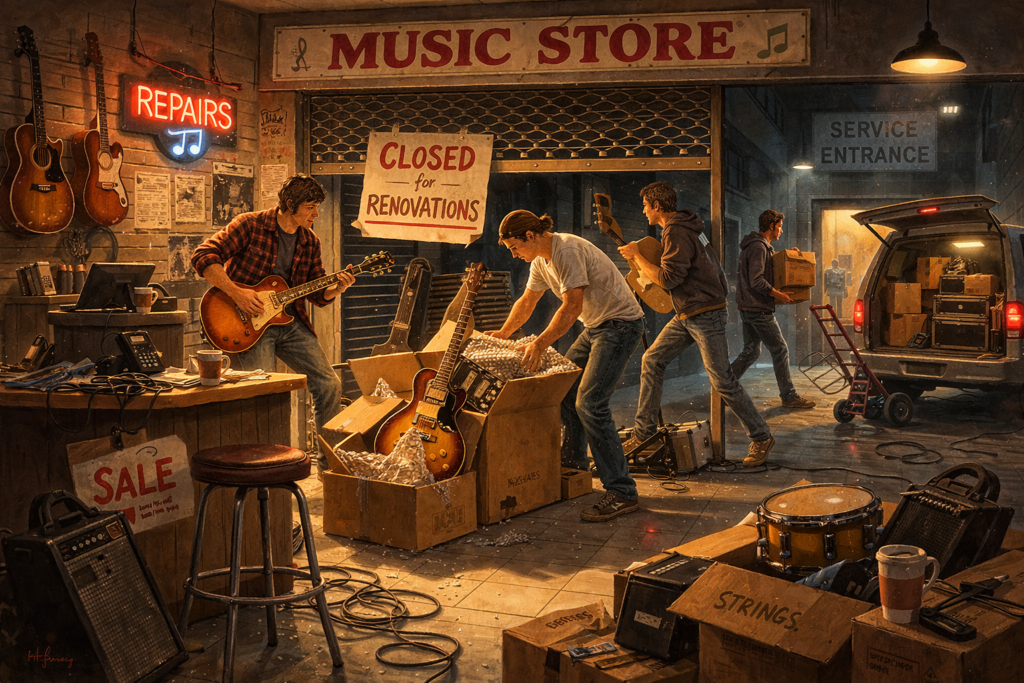
We were going to empty the store.
That night we showed up at the mall after hours. The security guard stopped us, which of course he had to do.
“What are you doing here?”
I told him we needed to do some overnight renovation work in the store, clean it up a bit before the next day.
He nodded and let us in.
Once we got to the storefront, we pulled down the metal gate and hung a curtain across the inside so nobody could see what was going on through the plexiglass.
And then we got to work.
Every guitar came off the wall. Every amplifier, every cable, every box of strings, every drum stand. If it could be lifted, it went into a box. If it could be carried, it went into the truck.
We had a vehicle waiting at the service entrance behind the mall. Through the back corridors we made trip after trip, hauling equipment through those quiet concrete hallways that normally only saw delivery carts and maintenance crews.
It felt like we were robbing the place.
At one point the security guard came around again.
He had noticed the traffic.
“What’s going on back here?” he asked.
I told him we were transferring some inventory between my locations.
Which technically wasn’t entirely untrue.
He seemed satisfied and moved along.
So we kept going.
Box after box. Guitar after guitar. Amplifiers stacked like bricks.
By the time we were finished, that entire 700-square-foot music store had been emptied out.
Everything ended up in my garage.
Now if you can picture this, my garage was about 200 square feet. Somehow we had just stuffed the contents of a 700-square-foot retail store into it. There were guitars leaning against lawn tools, amplifiers stacked beside bicycles, drum hardware piled in corners.
It looked like a musical instrument avalanche had exploded inside my house.
We were exhausted, but also strangely proud of ourselves.
We had pulled it off.
The next morning the phone rang.
It was the mall.
“What happened to your store?”
Apparently when they opened the gates that morning they found an empty retail space.
I explained the situation honestly. I told him I had fallen behind on the rent and I was afraid everything would be seized. I said I didn’t want to abandon the store, but the inventory was all I had.
There was a pause on the other end of the line.
Then he said something that stopped me cold.
“We’re not allowed to take your stuff.”
I remember just sitting there thinking, Oh.
All that panic.
All that effort.
The late-night operation that looked like a heist movie.
Completely unnecessary.
So later that day we loaded everything back up again.
The same guitars, the same amplifiers, the same boxes of strings. We reversed the entire process and rebuilt the store exactly as it had been.
I ended up working out a deal with the mall to stay until the end of the lease. The business didn’t last much longer after that, but at least it ended properly and not with a locked gate and empty hands.
For years afterward, whenever the guys and I talked about that time in our lives, that night always came up.
The night we stole my own music store.
There’s one last detail to the story that I didn’t learn until later.
The security guard who let us in that night?
Apparently he got fired.


What Am I?

My Experience With Suno and AI Music

The Hot Sauce I Put on Practically Everything
-

 Fashion9 years ago
These ’90s fashion trends are making a comeback in 2017
-
Fashion9 years ago
According to Dior Couture, this taboo fashion accessory is back
-
Business9 years ago
Uber and Lyft are finally available in all of New York State
-
Fashion9 years ago
Your comprehensive guide to this fall’s biggest trends
-
Fashion9 years ago
A photo diary of the nightlife scene from LA To Ibiza
-
Fashion9 years ago
Model Jocelyn Chew’s Instagram is the best vacation you’ve ever had
-
Business9 years ago
15 Habits that could be hurting your business relationships
-
Tech9 years ago
Startup adds beds and Wi-Fi to buses to turn them into ‘moving hotels’